


Welcome to the New Format
Starting tonight, Bitcoin Inspired evening brief has a new shape. It’s a teaching brief first and a market brief second.
When it arrives: Monday, Wednesday and Friday evenings at 8:00 PM Eastern, in time for an end-of-day review.
What it covers: Bitcoin, plus the altcoins that actually matter: Ethereum, Solana, XRP, stablecoins and Hyperliquid. Bitcoin is the yardstick here, not the punchline. You’ll get fair comparisons, not tribal ones.
What it won’t do: hype, or tell you where the price is going. The goal is steadiness, not prediction.
The spine: First Principles. For the next three weeks, each edition takes one idea from Satoshi’s nine-page whitepaper and runs it in order. That’s nine principles in nine editions, starting tonight with the first: Peer-to-Peer. Learn why each one exists, and you’ll understand Bitcoin better than most people who own it.
Every edition follows the same six steps:
The Discipline: a short Stoic open tied to the night’s idea
First Principles: one whitepaper line, decoded in plain English
How the Others Answered It: how the major altcoins handled the same problem, and what each trade-off means for you
Then & Now: a moment in history that tested the principle, set against today
The Board: a quick market check
In Your Control: one action you can take tonight, with nothing to predict
The market is loud. The principles are quiet, and they last longer. Let’s begin.
The Discipline
“Some things are in our control and others not.” (Epictetus, Enchiridion 1, c. 125 AD)
Epictetus began his handbook with a sorting exercise. Put each thing in one of two piles: what is up to you, and what is not. Then put your peace of mind only in the first pile.
A middleman belongs in the second pile. His honesty, his solvency and whether he lets you withdraw on a bad day are all up to him, not you. Tonight’s principle asks how much of your money’s fate sits in that second pile. It’s a good question for an evening review, the kind Seneca ran at the end of every day.
First Principles: Peer-to-Peer
“A purely peer-to-peer version of electronic cash” (Satoshi Nakamoto, Bitcoin whitepaper, Oct 31, 2008)
The plain-English version. Cash in your hand already works peer-to-peer. You hand someone a $20 bill, and no bank approves it. Online, that stopped being true. Every digital payment ran through a bank, card network or payment company that kept the books for everyone.
Satoshi wanted the online version of handing someone a bill. The payment goes straight from one party to the other, with no financial institution in the middle.
Why he needed it. The whitepaper’s introduction states the problem plainly: online commerce rests on trusting third parties, and that trust has costs. A middleman can reverse a payment, so merchants charge more and ask more questions. Small payments stop making sense. And the middleman can freeze, fail or say no.
Remove him and you have a hard new problem: who keeps the books, and how do you stop someone from spending the same money twice? That’s Friday’s principle. Every later piece of the whitepaper exists to make peer-to-peer work without bringing the middleman back.
How the Others Answered It
Every major network says it removes the middleman. The honest question is where some trust crept back in, and what it bought in return. Bitcoin is the yardstick: anyone can run a node, mine or send, and no one approves who gets to take part.
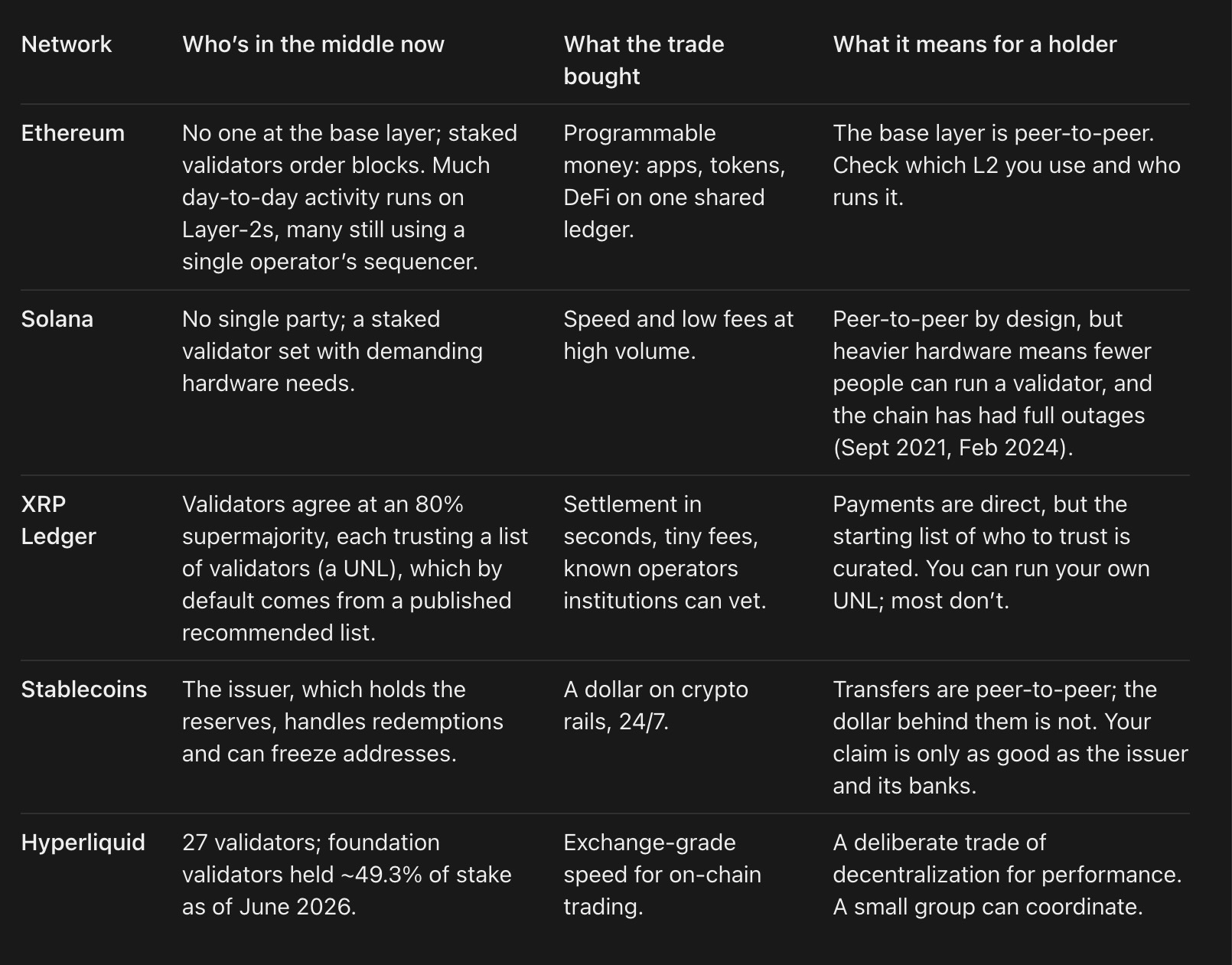
None of these trades is a scandal. Each is a choice made in the open. The holder’s job is to know which choice they bought.
Then & Now
Then: FTX, November 2022. Four years ago this month, the third-largest exchange in crypto said everything was fine. On Nov 8, 2022, after roughly $6 billion left in 72 hours, FTX paused withdrawals. It filed for bankruptcy on Nov 11. Customers who held their own coins felt the price drop. Customers who held IOUs at FTX lost access to everything.
Creditors were promised at least 118% of their account value, but priced at November 2022 levels, when bitcoin sat near its cycle low. Anyone who held their own BTC through that week kept the coins, and the rise that came after.
Now: November 2026. No exchange is failing tonight; the pressure is different. US spot bitcoin ETFs lost a net $239.9M on Nov 17, $209.5M of it from BlackRock’s IBIT, and November outflows are around $2.1B. ETFs are a legitimate, regulated choice, but they’re the middleman model rebuilt with better audits: the fund holds the coins, and you hold shares.
What it suggests. As more bitcoin sits with custodians, more of the market moves on what institutions do rather than what holders decide. That’s not a price prediction. It’s a reminder that peer-to-peer is something each holder chooses, or doesn’t.
Caveat: FTX is one event, and today’s ETF flows are a few weeks of data. Neither is a pattern to trade on.
The Board
The Fed set the tone today. The October minutes showed nearly all officials expect more rate hikes, and bitcoin slipped under $63,000. Fear & Greed read 11, which counts as extreme fear.
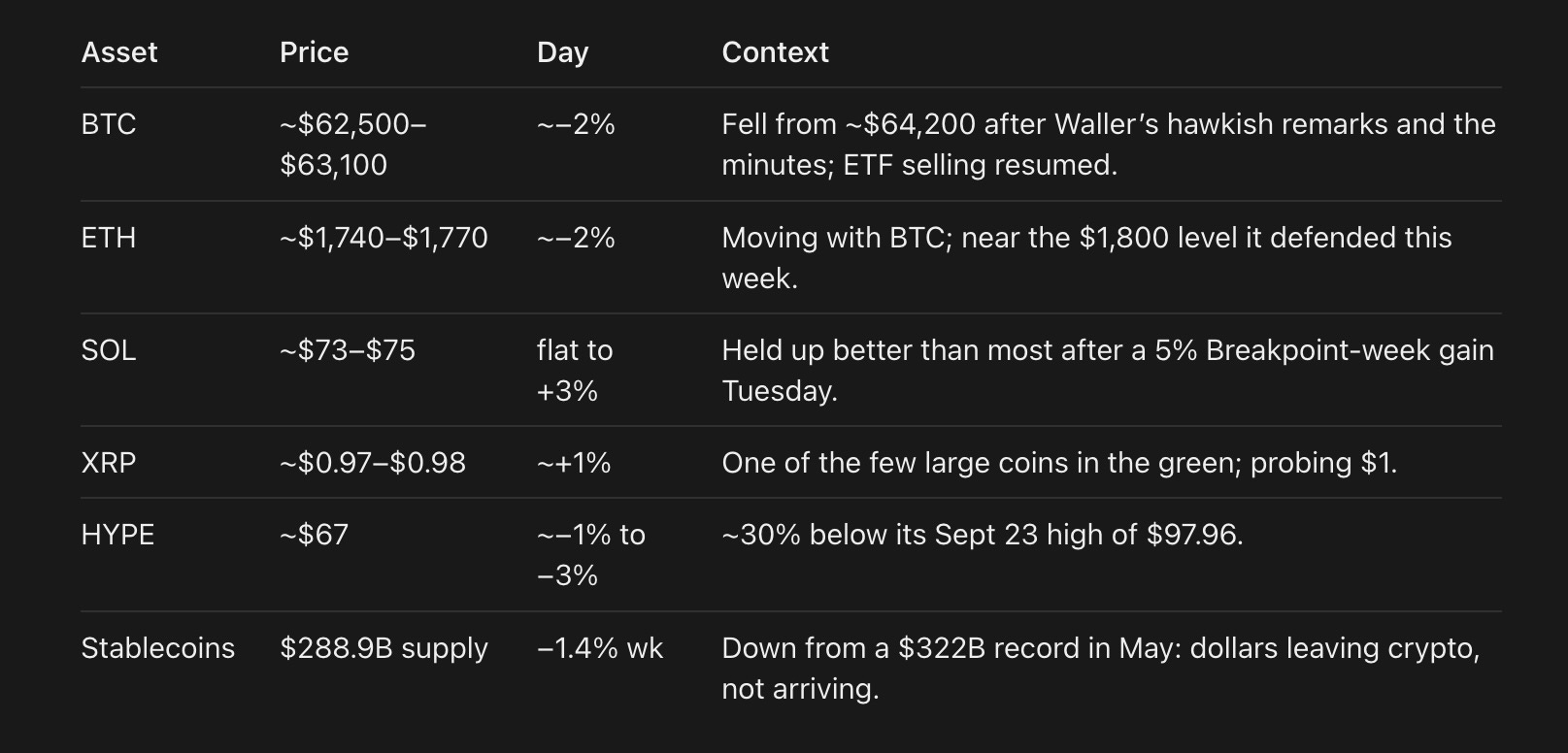
The steady read: a strong dollar and higher rates are weighing on everything that pays no yield, gold included. That’s weather, not a verdict on the thesis.
In Your Control
Sort your stack into Epictetus’s two piles. Write down where every coin you own sits: in a wallet where you hold the keys, on an exchange, or in an ETF or other fund.
The first pile is peer-to-peer; the rest carry a middleman. Either can be right for you, but know which you chose. If the second pile is bigger than you thought, tonight’s step is small: send a test amount to a wallet you control and confirm it arrived.
No price to predict. Just a ledger you can check.
Not financial advice. Next edition, Friday Nov 20: The Double-Spend Problem.