


Daily Crypto News | Thursday, November 12, 2026
Bitcoin is down near $72,500, Ethereum is barely holding $2,000, and the cryptocurrency market has lost another chunk of its value.
We’re also seeing reports of approximately $300 million in additional Bitcoin ETF outflows, concerns about Strategy’s position in a major stock index, and continued pressure on technology stocks.
And, of course, Jensen Huang and Nvidia are back in the news.

We’ve also got a pretty interesting conversation about Zcash developers, whether Crypto.com’s new trading-card products are actually Web3, and why cryptocurrency security keeps coming back to the same pr oblem: centralized systems.
But first, Bitcoin.
Bitcoin Falls Toward $72,000 as ETF Outflows Continue
Bitcoin has fallen to approximately $72,535, down 1.5% over the past 24 hours and nearly 9% over the past week.
Ethereum isn’t looking much better. It’s trading around $2,010, down approximately 16% over seven days.
Bitcoin ETFs reportedly recorded another $300 million in outflows, continuing the selling pressure we’ve been watching all week.
I’m not happy about this.
I thought the bottom was in. Everybody was talking about the bottom being in. But apparently Bitcoin is still trying to find it.
We’re breaking through support levels, and every time that happens, we have to start looking for the next one.
It’s kind of like watching an Avenger get thrown through the floor of a building.
He crashes through one floor, then another, then another, and you’re sitting there wondering when the hell he’s going to stop.
Hopefully before he reaches the ground.
Now, it’s worth remembering that Bitcoin was trading closer to $60,000 just a couple of months ago. So we’re not exactly looking at the end of the world here.
But the continued weakness, combined with institutional selling and pressure across risk assets, isn’t encouraging.
Nasdaq futures were reportedly down approximately 0.9%, while the S&P 500 had fallen around 0.4%.
The question is whether Bitcoin can find another level of support before the selling accelerates.
Nvidia’s Jensen Huang Becomes a Prediction Market Obsession

Nvidia’s leadership controversy continues to attract attention, and now prediction markets are getting involved.
Traders are reportedly placing bets on whether CEO Jensen Huang will resign or be removed by various dates, including the end of November, December, and March 2027.
I saw a longer-dated market showing an implied probability around 84% that Huang would eventually leave his position.
Do I believe it?
I don’t know.
I’ve been terrible at these prediction markets. Every time I think the crowd has something completely wrong, I bet against them and lose money.
But here’s what’s interesting.
The conversation has moved beyond the original allegations involving a woman suspected of having Chinese intelligence connections. Additional claims about Huang’s personal relationships are circulating, including reports involving a senior Nvidia healthcare executive.
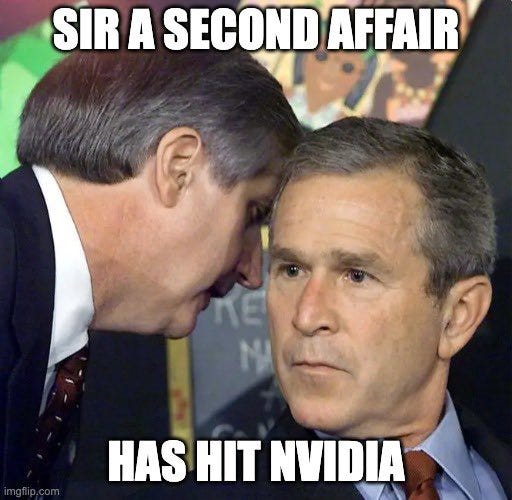
Those claims need to be established independently. I’m not treating rumors about someone’s private life as proven facts.
And frankly, I don’t care who Jensen Huang is sleeping with.
He’s an extraordinarily wealthy CEO running one of the most important technology companies in the world. I’m not particularly shocked that people are fascinated by his personal life.
But the actual question is whether any sensitive American technology, intellectual property, or national-security information was compromised.
That’s what matters.
The rest is gossip.
Nvidia’s Family Payroll Raises Questions About Corporate Governance
Another part of the Nvidia conversation involves Jensen Huang’s family.
Reports and online discussions have focused on the employment of Huang’s children, Spencer and Madison, and other relatives at Nvidia.
The claims include compensation figures exceeding $1 million annually, although those specific amounts have not been independently established in the material available for this newsletter.
Spencer reportedly moved into Nvidia’s robotics business after pursuing graduate business education.
Madison has reportedly worked within Nvidia’s software organization after an earlier background in culinary arts.
Now, having family members employed at a company isn’t automatically evidence of wrongdoing.
But when you’re talking about one of the world’s most valuable public companies, investors have a legitimate interest in governance, compensation, qualifications, and potential conflicts of interest.
And let’s be serious.
If your dad is worth $160 billion and you’re making a million dollars a year, wouldn’t you ask for a raise?
“Dad, can we make that five million?”
I’m kidding. Mostly.
But this is where the actual journalism should happen.
Not the gossip about someone’s marriage. The questions about how one of the world’s most important companies is governed.
Strategy Faces Potential Index Removal as Bitcoin Holdings Come Under Pressure

Michael Saylor’s Bitcoin treasury company, Strategy, is facing another potential challenge.
Reports suggest the company could be removed from a U.S. equity index, raising concerns that funds tracking that index might be required to sell Strategy shares.
That’s an important distinction.
This wouldn’t necessarily mean investors were selling because they had lost confidence in Bitcoin.
It could mean that index-tracking funds were adjusting their holdings because the company’s classification or index eligibility changed.
But that selling could still put pressure on Strategy’s stock.
And then there’s the company’s Bitcoin position.
With Bitcoin trading around $72,500, the market price is below the approximately $83,000 average acquisition price discussed in today’s episode.
That creates a difficult environment for a company whose identity is so closely tied to accumulating Bitcoin.
Strategy also has financing obligations associated with its preferred securities.
The company needs to manage cash flow and investor expectations while holding an asset that can experience substantial drawdowns.
Michael Saylor has been one of Bitcoin’s most vocal advocates for years.
But he’s not an original Bitcoin adopter. He arrived much later than the earliest participants in the industry.
And now he’s experiencing the same reality that everybody who holds Bitcoin eventually encounters.
Sometimes the price goes down.
A lot.
Why Is Zcash Falling? A Listener Raises an Interesting Question


Yesterday, we talked about Zcash getting absolutely hammered.
Today, it’s trading around $961.81, down approximately 27% over the past seven days.
A listener named Isaac sent me a message about a video featuring people associated with the Zcash development community.
The video apparently prompted some viewers to question whether the people building the project inspired confidence.
But that raises a much more interesting question.
What exactly does a trustworthy cryptocurrency developer look like?
Does wearing a suit make somebody a better programmer?
Does looking like the stereotypical tech nerd make someone more qualified to build decentralized infrastructure?
What about Vitalik Buterin?
He’s certainly not your conventional corporate executive.
And then there’s Satoshi Nakamoto.
We don’t even know who created Bitcoin.
We don’t know whether Satoshi was one person or a group. We don’t know their identity, background, or appearance.
Yet Bitcoin became the most successful cryptocurrency in history.
So why should the way a developer dresses or presents themselves determine whether we trust their code?
I don’t particularly care what developers look like.
I care whether the technology works.
If Zcash is falling because of concerns about the actual network, its economics, or its development, that’s worth investigating.
But if investors are making decisions based on whether developers fit some imaginary corporate image, I think they’re missing the point.
And to be clear, there’s no established evidence that the video Isaac mentioned caused Zcash’s decline.
Crypto.com’s Virtual Trading Cards: Is This Actually Web3?

Another listener, Skylar, asked about Crypto.com’s new virtual trading-card products.
The concept involves purchasing digital packs that can reveal collectible cards, including Pokémon and sports cards, with the possibility of redeeming certain cards for physical items.
It’s an interesting product.
But Skylar wanted to know whether these were actually decentralized, blockchain-based trading cards.
And that’s where the distinction matters.
Being able to purchase something using cryptocurrency doesn’t automatically make it decentralized.
Having a digital representation of a physical collectible doesn’t necessarily mean you own a transferable blockchain token.
And allowing customers to redeem a card for a physical item doesn’t establish that ownership is recorded on a public blockchain.
The product may provide legitimate access to real collectibles, but the recording doesn’t establish independently verifiable on-chain ownership.
This is one of my ongoing frustrations with the industry.
Everything gets labeled Web3, blockchain, or crypto.
But sometimes we’re simply talking about a conventional company operating a custodial marketplace and accepting cryptocurrency as payment.
That’s not necessarily a bad business.
It’s just not the same thing as decentralized ownership.
Chainstack Discloses Security Incident Involving AI-Assisted Attack Techniques
Blockchain infrastructure provider Chainstack has reportedly disclosed a security incident involving AI-assisted techniques that exposed customer information.
The company says the immediate threat has been contained, but potentially compromised credentials remain a concern.
Customers have reportedly been advised to rotate credentials and update passwords.
This is another example of a recurring problem in cryptocurrency security.
The underlying blockchain isn’t always what gets compromised.
Sometimes it’s the infrastructure surrounding it.
Cloud services, API credentials, employee accounts, authentication systems, and third-party software can all become attack vectors.
You can build a secure blockchain and still have serious problems if somebody gains access to the systems used to operate it.
That’s why basic security hygiene remains important.
Strong authentication, credential management, access controls, and monitoring aren’t particularly exciting.
But they’re essential.
Indian Crypto Exchange Faces Questions After 81,000 Wallets Reportedly Show Zero Balances
An Indian cryptocurrency exchange identified in today’s recording as UNICON is facing questions following reports that its website became inaccessible and approximately 81,000 wallets displayed zero balances.
Now, imagine opening your exchange account and seeing everything gone.
I’d freak out.
And I think most people would.
But there’s an important distinction between an exchange displaying a zero balance and the underlying cryptocurrency actually being stolen.
An exchange account balance is often a record maintained by the company’s internal systems.
A software failure, database issue, or temporary service interruption could produce an incorrect display without the assets necessarily having disappeared.
At the time of the report discussed in the episode, there was no verified explanation establishing that customer funds had been stolen.
So yes, customers should be concerned and demand answers.
But a zero balance on a website isn’t, by itself, proof of a hack.
South Korea Gives Crypto Exchanges More Authority to Freeze Transactions During Attacks

South Korea is introducing rules intended to give cryptocurrency exchanges greater flexibility to suspend deposits and withdrawals when they detect signs of a security attack.
The idea is straightforward.
If an exchange identifies suspicious activity, it may need to stop funds from moving before attackers can withdraw stolen assets.
That could help protect customers.
But there’s also a trade-off.
The more authority exchanges have to freeze transactions, the more control those centralized companies exercise over customer funds.
And that’s an important distinction in an industry that originally promised users greater financial independence.
Security matters.
But so does the ability to control your own assets.
The challenge is finding a balance between protecting customers from theft and giving centralized platforms too much discretion over access to their money.
Mark Manson, Capitalism, and Why Labels Destroy Nuance
Yesterday, we discussed a Mark Manson video about why the economy can appear healthy while people feel increasingly dissatisfied with their lives.
A listener named Malcolm asked which video I was referring to, and Skylar had some thoughts about its criticism of capitalism.
The video discusses the broader idea of enshittification, the gradual deterioration of products, services, and experiences as companies prioritize extracting more value.
And I think it’s an important conversation.
But here’s where people start getting lost.
If you criticize something about capitalism, suddenly somebody assumes you’re anti-capitalist.
If you defend free markets, somebody assumes you agree with every position associated with free-market capitalism.
I hate these labels.
Am I a capitalist?
I guess.
Probably more of a free-market capitalist.
But the moment you assign yourself a political or economic label, people start deciding what you believe before you’ve even explained your position.
You see the same thing with Democrats and Republicans.
A Democrat in California and a Democrat in Kansas might have very different views, but people treat the label as though it tells them everything.
It doesn’t.
There are things about capitalism that work extremely well.
There are also things about modern corporate behavior that deserve criticism.
We should be able to discuss both without pretending every conversation is a referendum on an entire economic system.
If you missed yesterday’s discussion, you can find it in the Daily Crypto News newsletter.
Cryptocurrency Market Snapshot
Prices recorded Thursday morning, November 12, 2026. These are the figures from the episode, not updated live prices.
Bitcoin (BTC): $72,535 | -1.5% in 24 hours | Approximately -9% in 7 days
Ethereum (ETH): $2,010 | -1.8% in 24 hours | -16% in 7 days
BNB: $655 | -3.8% in 24 hours
XRP: $1.03 | -2.0% in 24 hours | -21% in 7 days
Solana (SOL): $81.49 | -3.0% in 24 hours | -15% in 7 days
TRON (TRX): $0.315 | -0.4% in 24 hours | -0.8% in 7 days
Hyperliquid (HYPE): $70.33 | -3.2% in 24 hours | -14% in 7 days
Zcash (ZEC): $961.81 | -1.4% in 24 hours | -27% in 7 days
Total Crypto Market Capitalization: $2.4 trillion | -2.2% in 24 hours
Fear & Greed Index: 25 | Fear
It’s a brutal market out there.
Bitcoin is struggling to find support, Ethereum has lost approximately 16% in a week, and XRP and Zcash have taken even bigger hits.
But price isn’t the only thing worth watching.
We’re also seeing important questions about corporate governance, centralized exchanges, infrastructure security, and what decentralization actually means.
Those questions don’t disappear when Bitcoin starts going back up.
Thanks to Isaac, Skylar, Malcolm, and everybody else who continues sending in questions and comments.